Case study · Reddit-powered brand visibility
Social Insights.
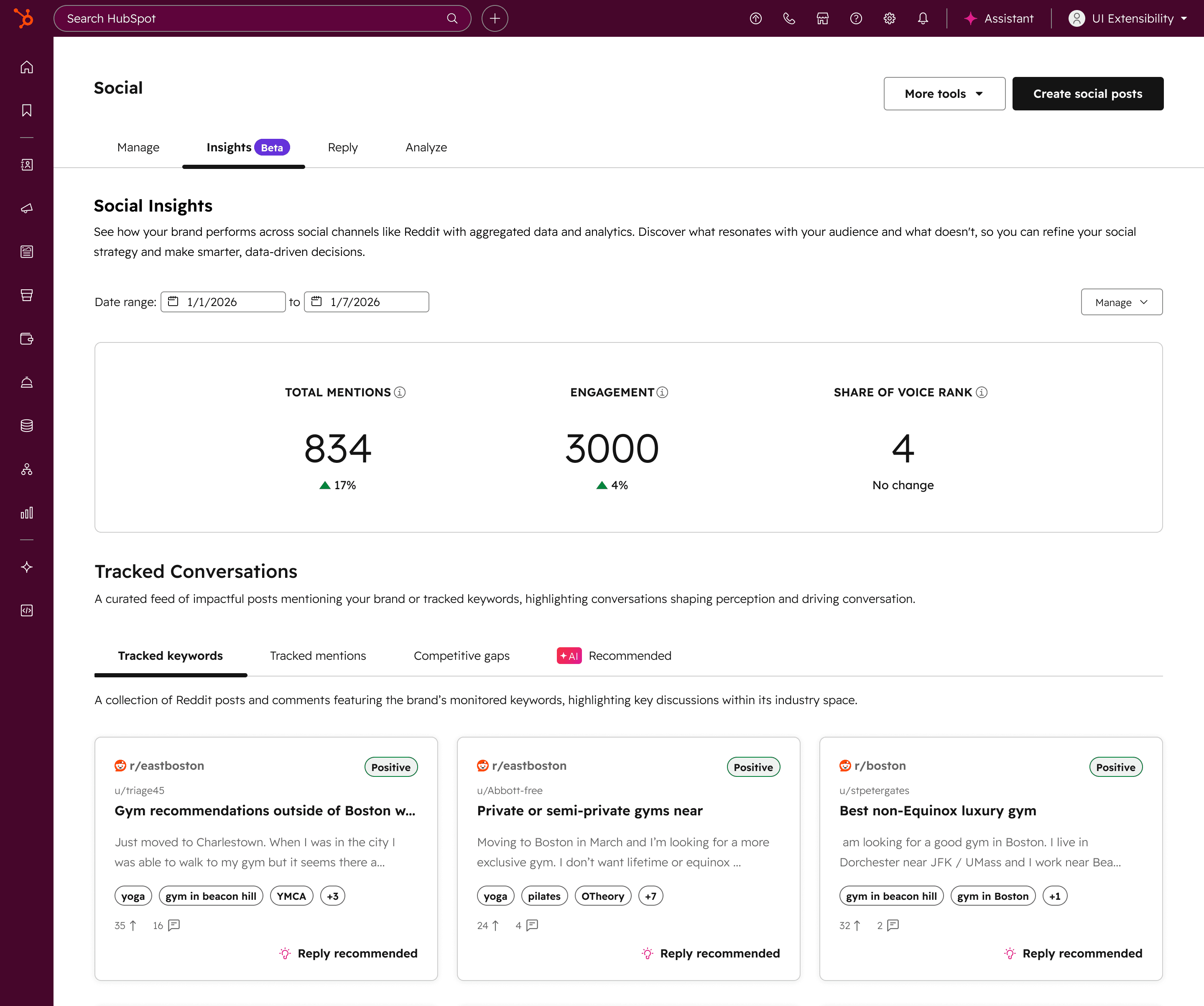
Turning Reddit conversations into brand insights marketers can act on. Currently, validated and shipped to a public beta inside HubSpot’s Marketing Hub.
- Role
- Senior Product Designer · sole designer
- Team
- Marketing analytics · 0→1 product
- Timeline
- 2026 · concept to public beta
- Priority
- Strategic 0→1 bet
The landscape
Where this sits
New to HubSpot? Here’s the ecosystem this work lives inside. Each step narrows the focus.
Level 01 · Platform
HubSpot
Marketing, sales, service, content, data and commerce teams all work from one shared customer record.
Level 02 · Hub
Marketing Hub
Where marketers plan campaigns, run social tasks, and measure how their brand is performing.
Level 03 · Product area
Brand Awareness
A new set of products focused on how a brand is seen, measured and grown.
Level 04 · This work
Social Insights
My team. We turn Reddit conversations into brand insights marketers can act on.
The brief
Help HubSpot’s strategic marketers turn Reddit conversations into confident decisions. The goal was a decision tool, not another social listening feed.
The problem
Users struggle to understand their customers’ sentiment about their brand because... insights are scattered across tools and lack context, leaving them reactive and unsure of their impact.
Who it’s for
The strategy-first marketer
Marketers who lead brand strategy at mid-market B2B and DTC companies. They synthesise signals from social, surveys and support channels, and want reports of patterns to take to leadership rather than more feeds to scan.
“Reddit is the source of truth. Surveys give you what people will say. Reddit gives you what they actually think.”

Marketing leader
Research
The hardest brand tasks
A large-scale, brand-focused survey surfaced that “Performance measurement & optimization” ranked second among the top brand tasks marketers struggle with.
Market research & analysis
Competitor analysis, target audience research, market opportunity analysis
Core brand strategy
Purpose, vision & mission, values, positioning, multi-brand strategy
Brand identity
Name, tagline, logo, color palette, typography, images & iconography, brand voice & tone
Messaging & storytelling
Key messaging pillars, brand story, value proposition
Brand governance & enablement
Brand guidelines, internal training, asset management
Communications
Content, ads or campaigns, public relations, social media management
Performance measurement & optimization
Brand tracking studies, social listening, sentiment analysis, analytics, brand audits, reputation management
The market
The competitive landscape
Before designing, I mapped the tools marketers already reach for, grouped by their strength and by where they leave the strategy-first marketer short. Each covers part of the job, but none turns a Reddit thread into a decision marketing leaders can act on.
Social listening suites
Brandwatch, Sprout, Meltwater
Strength
Broad cross-channel coverage. Mature dashboards and alerting.
Gap for the strategy-first marketer
Built for volume rather than synthesis. Marketers get feeds to scan when what they need is patterns they can act on.
Reddit-native scrapers
Brand24, smaller scrapers
Strength
Deep on Reddit. Cheap to run.
Gap for the strategy-first marketer
Sit outside the marketer’s daily tools. No bridge from a thread to a brand decision.
Survey & NPS tools
Qualtrics, in-product surveys
Strength
Structured, comparable signal. Good for tracking change over time.
Gap for the strategy-first marketer
Captures what people will say, not what they actually think when no one is watching.
Where we fit
Social Insights
Strength
Reddit-deep, and built inside the Marketing Hub where marketers already live.
Why it works
Patterns and themes instead of feeds, tied to the workflow marketers already use.
Approach
How I work
Four moves I make on every project, spanning design craft and the human work of keeping a team aligned.
Frame
Zoom out before zooming in. I map the ecosystem and align with PM and engineering on the real problem before any pixels.
Explore
Prototype several directions fast with AI tools, then pressure-test them with the team early so we commit on evidence instead of opinion.
Validate
Put work in front of real users mid-build. Weekly loops of build, share and refine keep design, engineering and leadership moving together.
Document
Turn unknowns into trade-offs the team owns and names. Every decision and its rationale gets written down, so we hold steady when direction shifts.
Design process
Iterate, validate, map friction.
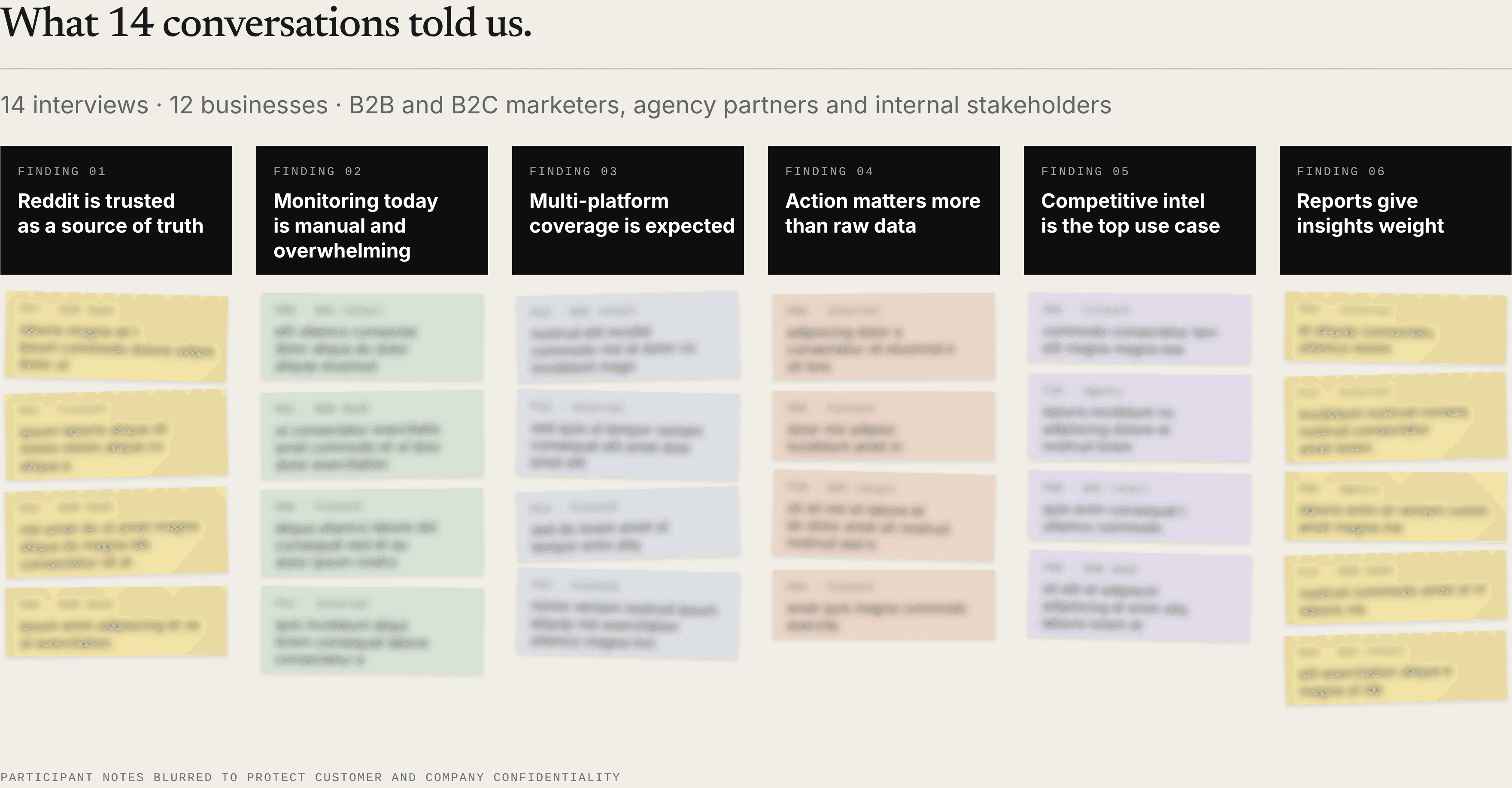
Weekly build, share and refine cycles with Loom walkthroughs, plus 14 user interviews mid-build. Approaching launch, a friction analysis turned unknowns into owned trade-offs, each with a plan for after the public beta.
- 01
Build
Repeat weeklyBuild the increment
- 02
Share
Loom walkthrough
- 03
Refine
Act on feedback
- 04
Friction analysis
Approaching launchBefore launch
Process
AI was a working partner
I use AI to run the legwork so I can spend the saved time on judgement. The thinking stays mine.
Rapid prototyping
Built prototypes to test three tool entry points in days rather than weeks, so leadership could see the product before anything was committed in Figma. That let us explore more directions without burning time.
Lovable · Claude · Conductor
Research artefacts
Synthesised interview notes into themes, drafted journey artefacts, and shaped the contingency-planning doc. Faster turnaround on the work that usually slows a project down.
Glean · Claude · NotebookLM
Pushing PRs
Wrote front-end code with AI assistance and pushed small PRs directly. This tightened handoff loops and let me prototype real interactions rather than static screens.
GitHub · Claude · Conductor
Craft
The system, shipped
Built on HubSpot's design system
Chose to extend existing patterns rather than reinvent. Every component decision had to earn its place against the system.
Three-step onboarding
Compressed a longer setup down to brand and domain only. Tested as the strongest entry flow in interviews.
Insight cards, not feeds
Designed the report unit as a scannable summary with named themes instead of a stream of posts, so there’s less to read and a faster decision at the end.
Impact at a glance
positive sentiment on the prototype across interview tasks. The three-step onboarding scored highest, tested with 14 marketing leaders across 12 businesses mid-build.
HubSpot customers ungated to the public beta.
of users complete onboarding and set the tool up.
Outcomes
What it added up to
Marketing leaders interviewed across 12 businesses
Mid-build validation coverage
Strategy pivots navigated without resetting engineering
Parallel design tracks held the line
Positive sentiment on the prototype across tasks
Three-step onboarding scored highest
Reddit reports shipped in the public beta
Day-one value for pilot users
Where it goes next
An AI-native take
The beta surfaces brand-relevant data. The next version should feel like a teammate. Here are three agentic moves I’m exploring, alongside a broader rethink of the Social home experience now in user testing.
Ask insights a question
A conversational agent on the dashboard that answers questions like “What should I do today?” or “Why is sentiment dropping?” in plain language, with the source posts attached.
Turn insights into next steps
When a marketer acts on a finding, an agent drafts the reply, social post or blog. They review, edit and approve, so they’re never starting from a blank page.
Proactive alerts
Notify users of significant sentiment shifts, competitors going viral on tracked channels, and high-impact posts that need a time-sensitive reply.
Challenges
Challenges & trade-offs
Challenge 01 · Channel
Reddit only at launch
Multi-channel was documented as the next investment. We focused on delivering deep, validated value through a single channel first rather than thin coverage across many.
Trade-off · Narrower scope, deeper validation on one surface.
Challenge 02 · Documentation
Friction mapped, not hidden
Every issue created by placing the tool inside the social space came with a resolution plan and a named owner, so unknowns turned into documented trade-offs instead of launch-day surprises.
Trade-off · More upfront documentation, no surprises at launch.
Reflection
Lessons & reflections
What worked
Friction documented becomes planned
Documenting friction before launch turned unknowns into owned, planned trade-offs. The team had a shared map of known risks and a named owner for each follow-up.
What worked
Parallel tracks survive pivots
Parallel design tracks through three strategy pivots meant we never started from scratch when direction changed. Build progress survived the uncertainty.
What I’d change
Sell the vision earlier
A future-state vision artefact alongside the tactical sprint work would have helped leadership see the why before the what. And I’d run user interviews earlier.